OMR Technology in Examination Systems: Evolution, Benefits, and Modern Applications in India
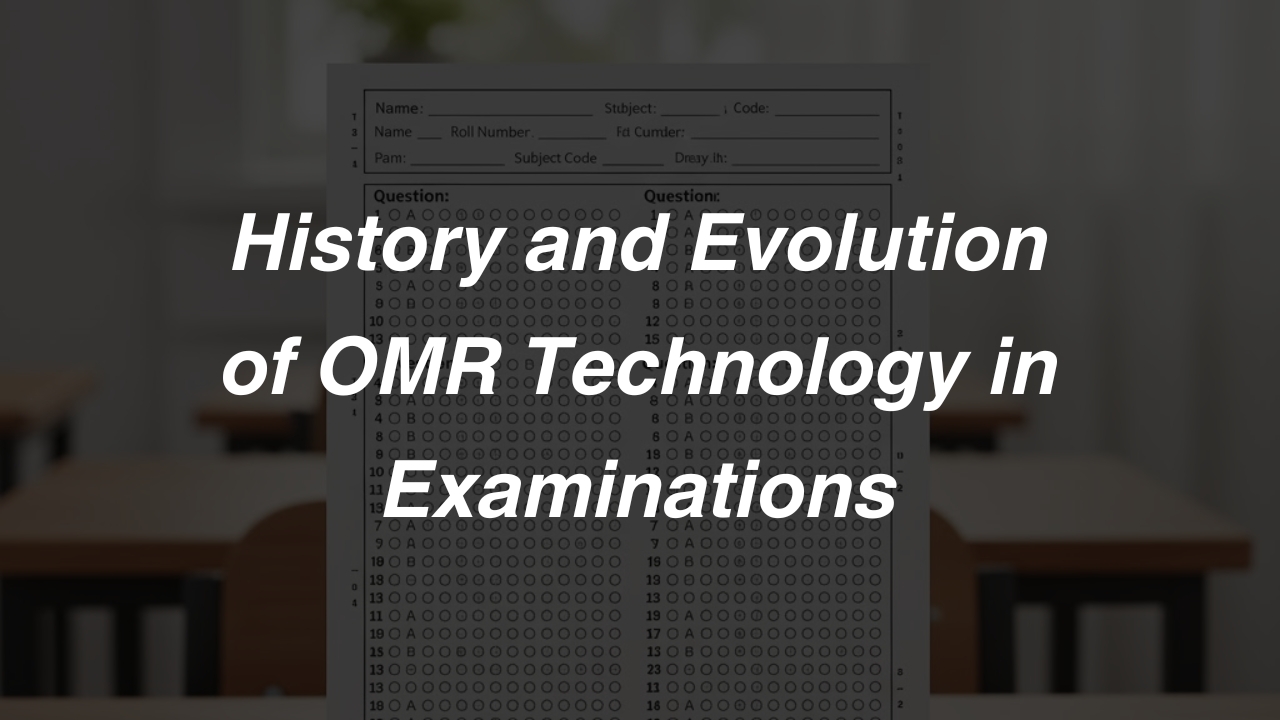
Introduction to OMR Technology in Exams
Optical Mark Recognition (OMR) technology has transformed how examinations are conducted and evaluated across India. Before the adoption of OMR-based exams, institutions relied on manual checking—a slow, error-prone, and resource-intensive process. As student populations expanded and competitive exams increased, the demand for fast, accurate, and scalable exam evaluation systems became critical. OMR technology emerged as a reliable solution, enabling automated reading of marked responses on paper-based answer sheets. Today, OMR examination systems are widely used by schools, colleges, coaching centers, government organizations, and corporate assessment teams across India.
What Is OMR Technology?
OMR (Optical Mark Recognition) is a technology that detects shaded or marked areas on specially designed answer sheets. It is widely used in examinations, surveys, and assessments where speed, accuracy, and scalability are critical.
- ✔ Automated answer sheet evaluation
- ✔ High-speed exam result processing
- ✔ Error-free score calculation
- ✔ Large-scale assessment handling
Examination Evaluation Before OMR
Before the adoption of OMR-based examinations, evaluation was conducted entirely through manual processes. Examiners reviewed each answer sheet individually, which resulted in significant inefficiencies and limitations.
Delayed result announcements
Human errors due to fatigue
Inconsistent marking standards
High operational costs
As examination volumes expanded—particularly across India’s education and recruitment sectors—manual evaluation methods became increasingly unsustainable, paving the way for automated OMR solutions.
Origin and Early Development of OMR Technology
OMR technology originated in the mid-20th century as a solution for large-scale data collection in surveys, census forms, and standardized questionnaires. Its ability to process vast volumes of paper quickly and with high accuracy made it an ideal choice for structured data capture.
As its reliability became evident, examination boards and educational institutions began adopting OMR for answer-sheet evaluation. This shift helped eliminate common grading challenges while ensuring fairness, consistency, and transparency in assessment outcomes.
Mid-20th Century
Initial development
Surveys & Census
Early applications
Education Sector
Examination adoption
Early Use of OMR in Examinations
The early adoption of OMR in exams was limited to controlled environments and objective-type questions. Multiple-choice tests were ideal, as each response could be evaluated uniformly.
Initial Benefits
- ✔ Faster evaluation compared to manual checking
- ✔ Consistent and unbiased scoring
- ✔ Reduced dependency on large evaluation teams
Growth of OMR-Based Exams in India
India became one of the largest users of OMR technology due to its ability to handle examinations at a massive scale with accuracy and efficiency.
- ● Large student populations
- ● High-volume government and competitive exams
- ● Increasing demand for transparent evaluation systems
Despite early limitations such as strict printing requirements and sensitive marking rules, OMR proved to be a reliable and scalable examination solution across India.
Transition from Mechanical to Software-Based OMR Systems
Mechanical OMR Scanners
Early OMR systems relied on physical scanners and hardware sensors. These machines were capable of processing thousands of answer sheets per hour, making them suitable for large-scale examinations.
Key Characteristics
- Expensive infrastructure and maintenance
- Difficult to modify once configured
- Limited flexibility in sheet design
Design Limitations
Any change in answer sheet layout or structure required physical and mechanical adjustments to the scanner, resulting in increased cost, downtime, and operational complexity.
Software-Based Digital OMR
Modern OMR systems leverage image processing and intelligent software algorithms to evaluate scanned answer sheets with exceptional speed and accuracy. This digital transformation has significantly enhanced efficiency, flexibility, and scalability.
Flexible Answer Sheet Design
Faster Processing Speeds
Advanced Error Detection
Cost-Effective Deployment
Today, software-based OMR solutions are widely adopted across educational institutions, recruitment agencies, and corporate environments—enabling large-scale assessments with speed, accuracy, and reliability.
Analytics and Reporting in Modern OMR Systems
Modern OMR examination software extends far beyond basic score calculation. Built-in analytics and reporting tools transform raw assessment data into actionable insights for educators and administrators.
Section-wise Performance Analysis
Identify strengths and weaknesses across subjects and topics.
Rank & Percentile Generation
Automatically compute rankings with accuracy and transparency.
Historical Performance Tracking
Monitor progress trends over multiple exams and sessions.
Data Export & Reporting
Export results for academic planning and decision-making.
These data-driven insights empower institutions to refine teaching methodologies, optimize assessment strategies, and ultimately improve learning outcomes at scale.
Role of Professional OMR Service Providers
As examination systems grew more complex, professional OMR service providers emerged to deliver secure, scalable, and fully managed OMR solutions.
Answer Sheet Design
Professionally designed OMR sheets optimized for accuracy and error reduction.
Secure Printing
Tamper-proof printing processes ensuring confidentiality and exam integrity.
Scanning & Evaluation
High-speed, accurate scanning with advanced validation mechanisms.
Results & Reporting
Comprehensive result processing with detailed analytics and reports.
Why Professional OMR Providers Matter
Their domain expertise ensures high accuracy, operational scalability, and strict compliance—making them indispensable for high-stakes examinations conducted at national and institutional levels.
OMR Technology in Today’s Examination Landscape
Even with the rapid growth of online examinations, OMR technology continues to play a critical role in reliable and large-scale assessment systems.
Limited Digital Infrastructure
Ideal for regions where internet connectivity and digital devices are unreliable or unavailable.
High-Security Examinations
Minimizes digital risks while ensuring confidentiality and exam integrity.
Large-Scale Offline Assessments
Efficiently handles lakhs of answer sheets with consistent accuracy.
OMR continues to be a cost-effective, accurate, and trusted examination evaluation method in India—bridging the gap between accessibility, security, and scalability.
Conclusion: The Future of OMR-Based Examination Systems
The evolution of OMR technology reflects the growing demand for reliable and scalable assessment solutions. From simple mark-reading machines to advanced analytics-driven platforms, OMR has firmly established itself as a cornerstone of modern examination systems.
With its ability to deliver fast results, detailed insights, and unmatched accuracy, OMR technology will continue to play a vital role in India’s education, recruitment, and corporate assessment ecosystem.
 Simplify complex operations with custom-built tech
 Ensure growth through automation and smart digital tools
 Reach wider audiences with scalable online infrastructure