Introduction
NEET preparation is fundamentally incomplete without structured, high-stakes mock tests. For coaching institutes, conducting regular, exam-format assessments is the only way to help students build the speed and accuracy required for success.
OMR-based mock tests create an environment identical to the actual NEET exam, making them a key diagnostic tool for student preparation.
Why OMR-Based Testing is Essential for NEET
The NEET exam is conducted entirely on OMR answer sheets. For students, familiarity with this specific format is not just a bonus—it is a critical necessity for survival on exam day.
Coaching institutes can explore solutions on the MultiGraphics website to understand how professional infrastructure supports large-scale testing. Here is why a robust coaching institute testing system must remain OMR-centric :
Format Accuracy : Practicing on an OMR sheet for NEET eliminates surprises, ensuring students are comfortable with the physical layout of the paper.
Error Awareness : Early exposure helps students avoid common pitfalls, such as incomplete bubble filling, stray marks, and incorrect roll number entries.
Time Discipline : OMR tests enforce real conditions, training students to manage 200 questions within the strict 3-hour and 20-minute window.
Objective Evaluation : Automated scanning removes human bias and manual errors from result processing, ensuring every student is evaluated fairly.
Analytics-Ready Data : Scanned data provides a goldmine of information, allowing faculty to analyze performance at both individual and batch levels.
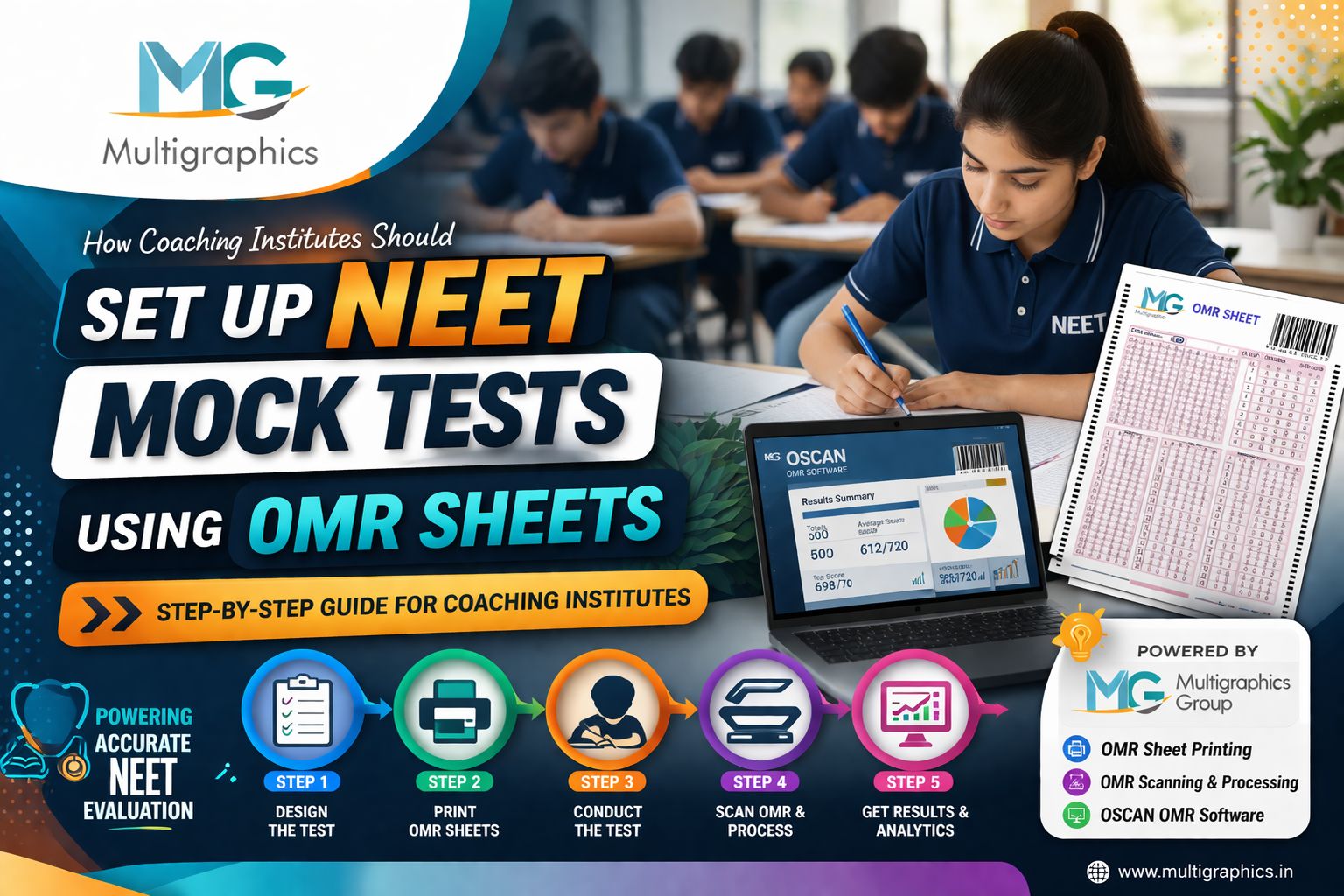
Step 1: Design the NEET Mock Test Paper
A successful NEET mock test setup begins with the preparation of the question paper. If the paper does not align with the National Testing Agency (NTA) standards, the mock test loses its predictive value.
Key Design Considerations:
Follow Official Structure : Use 200 questions across Physics, Chemistry, Botany, and Zoology. Ensure Section A is mandatory while Section B offers the "attempt five of ten" choice.
Correct Marking Schemes : Implement the +4 for correct and -1 for incorrect marking system to train students on risk management.
Difficulty Distribution : Aim for a balanced ratio of 30% easy, 50% moderate, and 20% difficult questions per subject.
Rotate Question Sets : Use different sets across various batches to prevent paper circulation and maintain the integrity of the test.
Match NTA Style : Use the same font clarity and instruction format as official papers to reduce cognitive load during the actual exam.
Step 2: Design and Print the OMR Sheet
The OMR sheet must correspond exactly with the question paper. Any mismatch in question numbering or section boundaries will lead to catastrophic errors during the OMR scanning process.
High-quality printing is the backbone of accurate data capture. Institutes should consistently utilize professional OMR sheet printing services to ensure technical specifications are met.
Information Block : Dedicated space for student name, roll number, date of birth, and test booklet code.
Distinct Sections : Visually clear divisions for the four subjects to prevent students from marking answers in the wrong grid.
Registration Marks : Precise corner markers that guide the high-speed scanner during optical reading.
Paper Quality : Sheets should be printed on 80–100 GSM paper to prevent ink bleed and ensure durability during handling.
Consistent bubble size and precise grid alignment are mandatory. MultiGraphics prioritizes technical precision for each batch.
Step 3: Conduct the Test Efficiently
Test day management determines the quality of the data you will eventually scan. Disruptions during the session can lead to incorrectly filled sheets that fail during processing.
Before and During the Session:
- • Brief students on the correct way to fill bubbles using only black or blue ballpoint pens.
- • Explicitly forbid the use of pencils or gel pens, as these can cause errors in OMR scanning and processing solutions.
- • Announce time remaining at key intervals (60, 30, and 10 minutes) to help students pace their bubble-filling strategy.
- • Supervisors must actively monitor students to ensure booklet codes and roll numbers are filled before the session ends.
Post-Test Handling:
- • Collect sheets face-up and maintain them in roll number order.
- • Never fold, staple, or clip OMR sheets together, as physical damage prevents them from passing through the scanner feed.
- • Store all sheets in a dry, flat environment until they are ready for the scanning phase.
Step 4: Execute the OMR Scanning Process
This stage converts physical marks into digital data. While the technology is fast, its accuracy relies on the condition of the sheets and the software utilized.
Before beginning, staff should inspect the batch for torn edges or heavy creasing. Once prepared, the high-speed OMR scanning and processing solutions take over, reading thousands of sheets per hour.
Modern systems map every response to the pre-loaded answer key. If the software detects a misread or an ambiguous mark, it flags the sheet for manual review. This ensures that the system never produces a "silent error," protecting the student's hard work.
Step 5: Process Results and Analyse Performance
Raw data is only valuable if it is translated into actionable insights. This is where OSCAN OMR software becomes indispensable for a modern coaching institute.
By using professional software, institutes can generate :
Subject-Wise Breakdowns : Detailed scorecards showing exactly where a student stands in Physics versus Biology.
Batch Rank Lists : Internal rankings for healthy competition and performance tracking.
Question-Level Analytics : Reports that identify which specific questions were most frequently missed, indicating a need for classroom re-teaching.
Custom Templates : Highly professional report cards that can be branded and shared directly with parents.
Utilizing custom OMR solutions for institutes ensures that the feedback loop is closed quickly, allowing teachers to adjust their lesson plans based on real-time data.
Common Mistakes Coaching Institutes Should Avoid
To maintain a high-quality testing environment, avoid these frequent pitfalls:
Low-Quality Printing : Poorly aligned grids are the number one cause of batch-wide scanning failures.
Neglecting Briefings : Never assume a student remembers the filling rules; always reiterate them before the clock starts.
Manual Answer Keys : Relying on manual entry for answer keys is risky. Always have two faculty members verify the digital key in the OSCAN OMR software before running the results.
Incomplete Reporting : Sharing only a total score wastes the diagnostic potential of the test. Always provide subject-level depth.
Conclusion
A well-executed NEET mock test does more than just provide a score; it builds the stamina and precision required for one of the world’s toughest exams. By establishing a repeatable, professional process—from design to analytics—institutes provide their students with a genuine competitive advantage.
MultiGraphics supports coaching centers through every phase of this workflow, offering custom OMR solutions for institutes that prioritize accuracy and speed. When the infrastructure behind the test is flawless, students can focus entirely on their performance.
For those ready to upgrade their internal systems, you can learn more about these services at MultiGraphics or explore our official blogs.
About Us
India's Leading
EdTech Solution Provider
We don't just build tech — we build results.
Multigraphics Group builds scalable solutions across EdTech, training, software development, mobile apps, digital marketing, and exam tech.
We help institutions and businesses automate, digitize, and grow — using the systems and resources they already have.
-
 Simplify complex operations with custom-built tech
-
 Ensure growth through automation and smart digital tools
-
 Reach wider audiences with scalable online infrastructure