By Multigraphics | Jan 27, 2026 | Blogs
How OMR Sheets Work: Step-by-Step Explanation
Introduction
Imagine an examination hall filled with hundreds—or even thousands—of candidates. Each participant completes a multiple-choice test, and once the exam ends, every answer sheet must be evaluated accurately, fairly, and within a short time frame. Manual checking would take days, require large teams of evaluators, and still leave room for human error.
This is where OMR (Optical Mark Recognition) sheets play a critical role. From school assessments and coaching institute tests to government recruitment exams and corporate evaluations, OMR sheets enable fast, reliable, and consistent exam evaluation.
While the technology may seem complex at first, the OMR process is quite simple when explained step by step. In this guide, we break down how OMR sheets work, their role in modern examinations, and why they remain essential across India’s education and assessment ecosystem.
Step 1: Designing the OMR Sheet
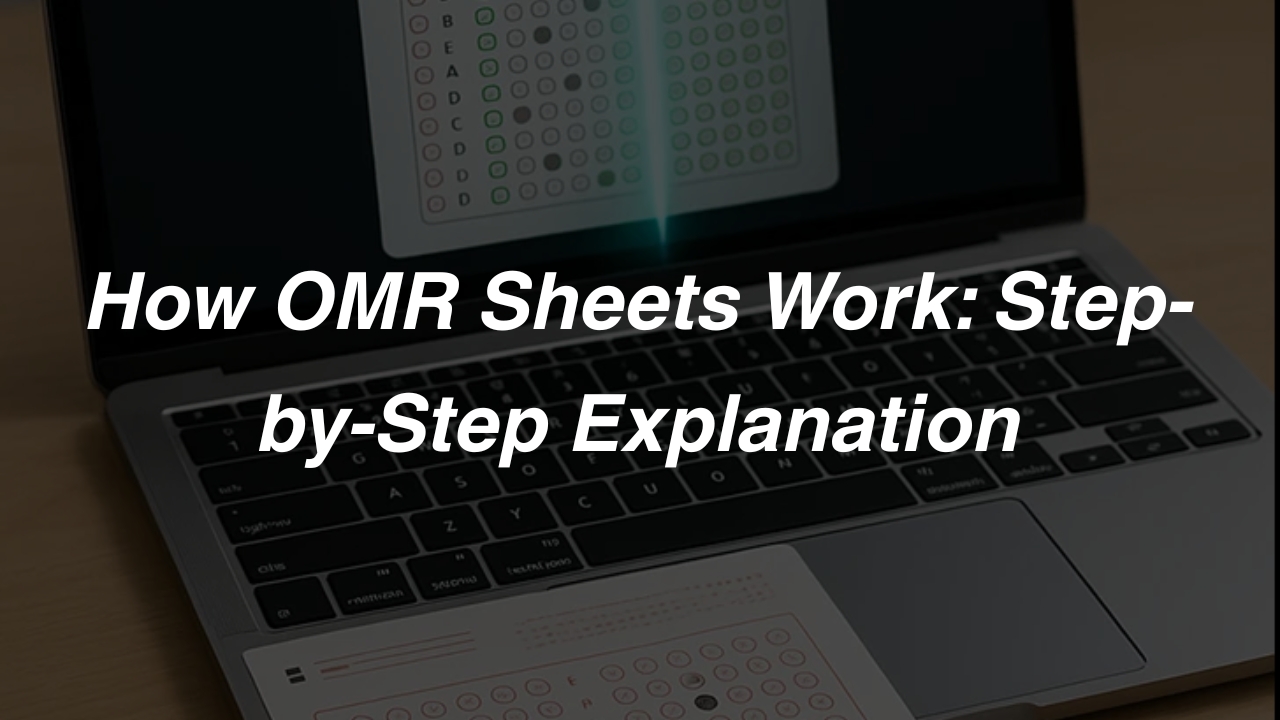
The foundation of any OMR-based exam is the OMR answer sheet design. Unlike regular answer sheets, OMR sheets are specially formatted for machine readability and typically include:
- Candidate Information Section: : Fields for name, roll number, registration ID, or barcode to uniquely identify each candidate
- Question & Answer Section: Uniformly arranged bubbles (A, B, C, D, or E) that scanners can detect accurately
- Instruction Section: Guidelines on how to mark answers, which pen or pencil to use, and handling instructions
Precision in layout and printing is critical. Even minor misalignments can affect scanning accuracy. Professional OMR providers like Multigraphics follow strict design and printing standards to ensure error-free evaluation.
Step 2: Marking the Answers
Candidates mark their responses by darkening the appropriate bubbles on the OMR sheet. To ensure accurate detection, candidates must:
- Use the specified pen or pencil
- Fill bubbles completely and neatly
- Avoid stray marks or overwriting
- Keep the sheet flat and undamaged
Proper marking is essential, especially in large-scale exams, where even small errors can impact results.
Step 3: Collecting the OMR Sheets
After the exam, answer sheets are collected securely and often grouped into batches for efficient processing. Careful handling is crucial, as folds, smudges, or physical damage can interfere with scanning accuracy.
In large examinations—such as government recruitment or university entrance tests—collection and tracking of thousands of sheets across multiple centers require strong logistical control, which professional OMR service providers manage effectively.
Step 4: Scanning the OMR Sheets
Collected sheets are scanned using one of the following methods:
- Dedicated OMR scanners – hardware machines designed specifically for reading marked bubbles
- High-resolution scanners with OMR software – scanned images analyzed digitally using image processing algorithms
OMR systems detect differences in reflectivity between marked and unmarked areas. Alignment markers on the sheet help the system correctly locate rows and columns, converting physical markings into digital data.
Step 5: Automated Evaluation
Once scanned, the OMR software evaluates responses by matching them with a predefined answer key. The system automatically identifies:
- Correct and incorrect answers
- Unanswered questions
- Invalid responses (such as multiple markings where only one is allowed)
Automated evaluation eliminates human bias and significantly reduces processing time, making it ideal for competitive exams and high-volume assessments.
Step 6: Result Generation and Reporting
After evaluation, the system generates results and detailed reports. Modern OMR solutions provide:
- Individual scorecards
- Section-wise or subject-wise analysis
- Batch, class, or group comparisons
- Rankings and percentiles for competitive exams
These reports can be exported digitally or printed, enabling institutions to use exam data for performance analysis and academic planning.
Step 7: Secure Data Storage
Post-evaluation, scanned answer sheets and result data are stored securely in digital formats. Secure data storage ensures:
- Easy access for audits or rechecking
- Compliance with institutional or regulatory requirements
- Protection of sensitive candidate information
Professional platforms offer secure data management systems that reduce the risk of data loss or breaches.
Advantages of Using OMR Sheets
OMR-based exams offer several benefits, including:
- High accuracy by minimizing human error
- Faster result processing compared to manual checking
- Scalability for hundreds or thousands of candidates
- Consistency in evaluation standards
- Actionable insights through performance analytics
These advantages make OMR sheets a preferred choice across education, government, and corporate assessments.
Common Pitfalls to Avoid
Despite their reliability, OMR systems can face issues if best practices are not followed, such as:
- Light or incomplete markings
- Poor-quality printing
- Improper handling causing folds or smudges
- Incorrect alignment during scanning
Partnering with experienced OMR service providers helps institutions avoid these challenges and ensures smooth exam execution.
Conclusion
OMR sheets have revolutionized the way exams are conducted and evaluated. From precise answer sheet design and accurate scanning to automated evaluation and secure result management, each step plays a vital role in delivering fair and efficient assessments.
For schools, coaching centers, government bodies, and corporate organizations in India, understanding how OMR sheets work is essential. End-to-end solutions from trusted providers simplify the entire process, allowing institutions to focus on education and decision-making rather than manual evaluation.
As examination systems continue to evolve, OMR technology remains a proven, scalable, and dependable solution in today’s assessment landscape.
 Simplify complex operations with custom-built tech
 Ensure growth through automation and smart digital tools
 Reach wider audiences with scalable online infrastructure