Understand essential OMR terminologies in detail. A comprehensive guide for schools, universities, government exams, and corporate assessments in India.
Introduction
OMR-based testing has become a backbone of modern examinations in India. From school-level assessments and coaching institute mock tests to large-scale government recruitment examinations and corporate evaluations, Optical Mark Recognition (OMR) technology enables fast, accurate, and scalable result processing.
Despite its widespread use, many students, educators, and even administrators are unfamiliar with the technical terminology associated with OMR systems. Terms such as answer key, timing marks, threshold level, invalid response, and data capture are frequently used but rarely explained in simple language.
This comprehensive guide explains the most important terminologies used in OMR-based testing in a clear and structured manner, helping beginners and professionals alike understand how the system works behind the scenes.
What Is OMR (Optical Mark Recognition)?
OMR stands for Optical Mark Recognition. It is a technology used to detect human-made marks on specially designed printed sheets. In examinations, candidates fill bubbles corresponding to their answers, and OMR systems scan these sheets to convert marked responses into digital data.
Unlike handwriting recognition, OMR does not interpret text. Instead, it detects contrast, position, and alignment of marks. This makes it highly reliable for objective-type examinations involving multiple-choice questions.
OMR Sheet (Answer Sheet)
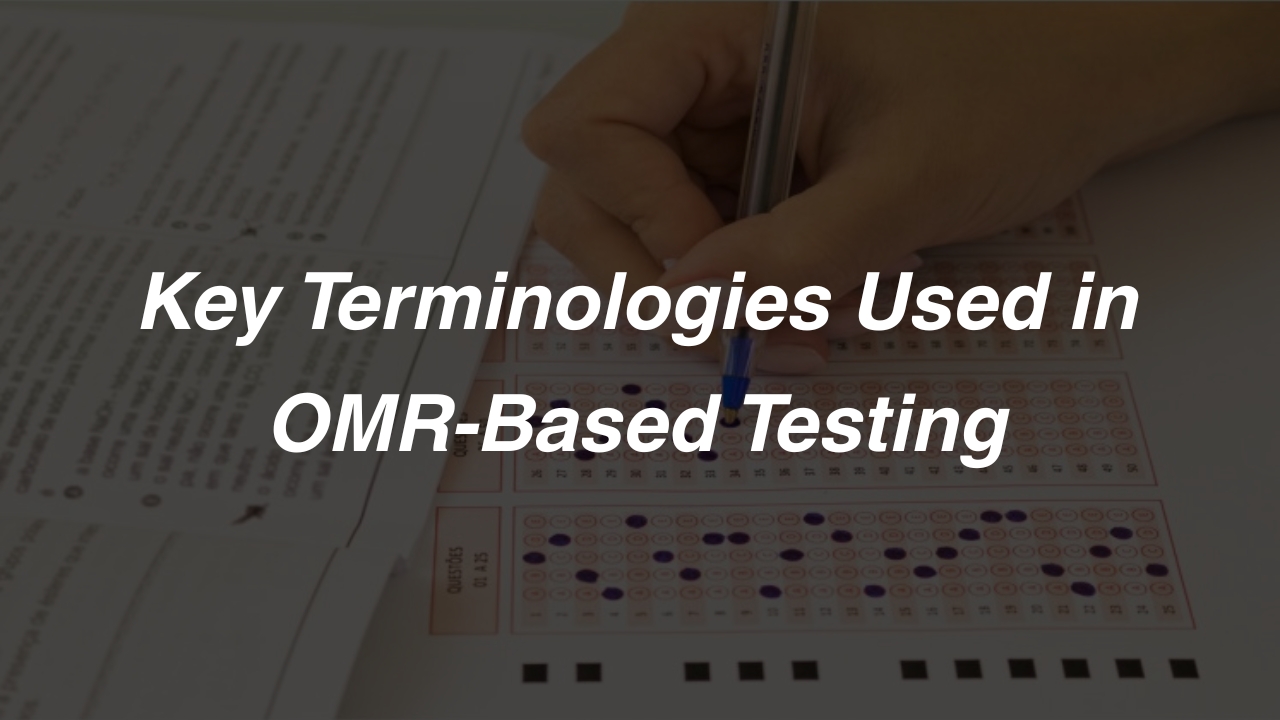
An OMR sheet is a specially formatted document designed for machine readability. Its layout ensures that scanners can accurately identify candidate responses and personal information.
- A standard OMR sheet includes:
- • Candidate information section
- • Question numbers with multiple-choice answer bubbles
- • Alignment or timing marks
- • Instructions for proper marking
The design quality of the OMR sheet directly impacts scanning accuracy. Professionally printed sheets minimize errors during high-speed processing.
Response Bubble
A response bubble is the circle or box that a candidate fills to indicate their selected answer. These bubbles are the primary elements detected by OMR scanners.
- Important guidelines include:
- • Fill the bubble completely and darkly
- • Mark only one bubble per question
- • Avoid tick marks, crosses, or partial shading
Answer Key
The answer key is the official set of correct responses used to evaluate candidate sheets. It is uploaded into the OMR software before result processing begins.
The system compares each candidate’s marked responses with the answer key to calculate scores. Any error in the answer key can lead to incorrect evaluation, making it one of the most critical components in OMR testing.
OMR Scanner
An OMR scanner is the device or software responsible for reading marked sheets. Some institutions use dedicated OMR hardware scanners, while others use high-speed document scanners integrated with OMR software.
The scanner identifies filled bubbles by detecting reflectivity differences between shaded and unshaded areas.
Timing Marks / Alignment Marks
Timing marks are small black squares or lines printed along the edges of the OMR sheet. They help the scanner correctly align the sheet and identify exact row and column positions.
Any damage or markings near these areas may affect scanning precision.
Roll Number Grid / Registration Grid
This section allows candidates to mark their roll number or registration ID using digit-wise bubble columns. Proper marking ensures the sheet is linked to the correct candidate during data processing.
Threshold Level
The threshold level refers to the minimum darkness required for a bubble to be recognized as valid. Marks lighter than this threshold may not be detected, which is why uniform shading is essential.
Multiple Marking
Multiple marking refers to selecting more than one answer for a single question. OMR systems typically flag such responses as invalid to maintain fairness.
Blank Response
A blank response means no bubble has been filled for a particular question. It is usually treated as unattempted and awarded zero marks.
Scanning Resolution
Scanning resolution refers to the quality and clarity at which sheets are scanned. Higher resolution improves accuracy but must be balanced with processing speed for large-scale exams.
Data Capture
Data capture is the process of converting physical markings into digital information. This data is then matched with the answer key and stored securely for result generation.
Result Processing
Result processing involves score calculation, section-wise performance analysis, and rank generation. Modern OMR systems can generate reports within hours, even for thousands of candidates.
Error Logs / Exception Reports
Error logs are system-generated reports that highlight ambiguous markings, identification mismatches, or technical issues. Administrators can review these cases manually to ensure transparency.
Conclusion
Understanding OMR terminology empowers students, teachers, and administrators to conduct and participate in exams with confidence. Each term represents an essential part of a system designed to ensure speed, fairness, and accuracy in modern assessments.
As India continues to conduct examinations at a massive scale, clarity in OMR processes and terminology remains crucial for maintaining trust and reliability.
 Simplify complex operations with custom-built tech
 Ensure growth through automation and smart digital tools
 Reach wider audiences with scalable online infrastructure