By Multigraphics | Feb 02, 2026 | Blogs
Manual Exams vs OMR Exams: A Comparative Study
Introduction
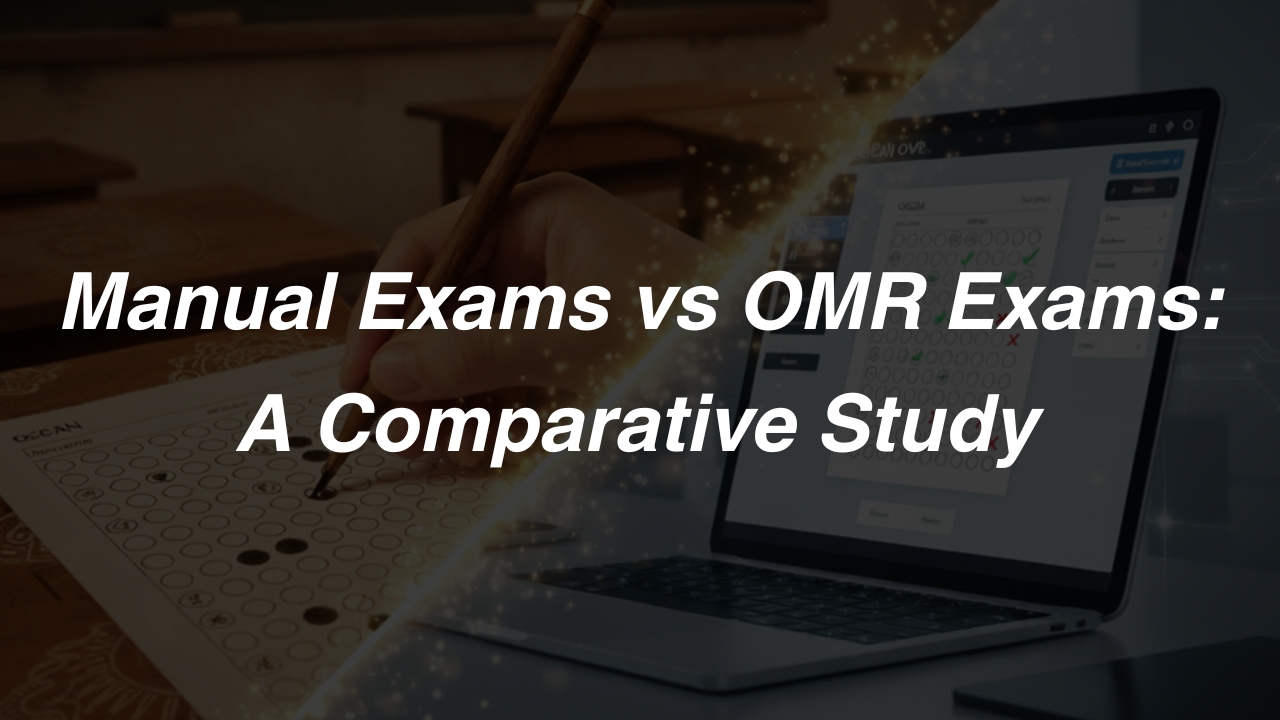
Examinations play a vital role in education, recruitment, and skill assessment. For decades, institutions relied on manual exams, where answer sheets were evaluated by teachers or examiners. While this traditional method has proven effective for subjective assessment, it becomes challenging when dealing with large-scale examinations.
The emergence of OMR (Optical Mark Recognition) exams has revolutionized assessment processes by enabling fast, accurate, and automated evaluation of objective-type questions. Today, institutions must carefully choose between manual and OMR exams—or a combination of both—based on their assessment goals.
This comparative study explores the key differences, advantages, and limitations of manual and OMR exams to help educators, administrators, and decision-makers make informed choices.
What Are Manual Exams?
Manual exams are traditional assessments where candidates write answers on paper and evaluators manually review and grade each response. These exams may include multiple-choice questions, short answers, long-form responses, essays, or diagrams.
Characteristics of Manual Exams
- Human Evaluation: Each answer is checked by teachers or examiners.
- Flexible Question Formats: Suitable for essays, descriptive answers, and creative responses.
- Time-Intensive: Requires significant time and manpower, especially for large candidate pools.
- Subjectivity: Evaluation may vary due to human judgment, fatigue, or interpretation.
Despite these challenges, manual exams remain essential for assessing critical thinking, analytical ability, creativity, and communication skills—areas that automated systems cannot fully evaluate.
What Are OMR Exams?
OMR exams are designed for objective-type questions, where candidates mark their responses on specially designed OMR sheets. These sheets are scanned and evaluated using software or scanners to generate results automatically.
Key Features of OMR Exams
- Automated Evaluation: Fast and error-free assessment without human intervention.
- High Accuracy: Eliminates marking and calculation errors common in manual checking.
- Speed and Efficiency: Thousands of answer sheets can be processed within hours.
- Standardized Assessment: Uniform evaluation ensures fairness and consistency.
OMR exams are widely used in schools, coaching institutes, government recruitment tests, entrance exams, and corporate assessments.
Comparative Analysis
1.Accuracy
Manual Exams: Accuracy depends on the evaluator and may be affected by fatigue or subjectivity.
OMR Exams: Extremely accurate, as responses are evaluated strictly against predefined answer keys.
2.Time Efficiency
Manual Exams:Evaluation can take days or weeks for large-scale exams.
OMR Exams: Results are generated within hours, making them ideal for high-volume assessments.
3. Scalability
Manual Exams:Manual Exams: Scaling requires more evaluators, increasing complexity and cost.
OMR Exams: Easily scalable and capable of handling thousands of answer sheets simultaneously.
4. Cost
Manual Exams:Manual Exams: Higher long-term costs due to manpower and extended evaluation time.
OMR Exams: Initial setup costs exist, but automation significantly reduces ongoing operational expenses.
5. Flexibility of Question Format
Manual Exams:Manual Exams: Ideal for essays, long answers, and subjective evaluation.
OMR Exams: Limited to multiple-choice and objective questions.
6. Data and Analytics
Manual Exams: Performance analysis is manual and time-consuming.
OMR Exams: Offers instant reports, section-wise analysis, rankings, and performance trends—valuable for academic planning and training programs.
Real-World Applications
Manual Exams
- University and school descriptive examinations
- Research evaluations and thesis assessments
- Skill-based assessments in language, arts, and technical subjects
OMR Exams
- School and board-level assessments
- Government recruitment and competitive entrance exams
- Corporate training and large-scale skill evaluations
Each system serves a specific purpose depending on the nature of the assessment.
Hybrid Approach: Combining Manual and OMR Exams
Many institutions now adopt a hybrid evaluation model to leverage the strengths of both systems:
- School Assessments: Objective questions evaluated via OMR, while essays are checked manually.
- Entrance Exams: OMR-based MCQs combined with interviews or written descriptive tests.
This approach ensures speed, accuracy, and fairness while preserving the depth of subjective evaluation.
Conclusion
The choice between manual and OMR exams depends on factors such as exam scale, question type, accuracy requirements, and available resources.
- Manual Exams: Best suited for small-scale or subjective assessments.
- OMR Exams: Ideal for large-scale, objective evaluations where speed, consistency, and accuracy are critical.
For schools, coaching institutes, government bodies, and corporate organizations in India, understanding this comparison is essential for designing effective assessment strategies. Professional OMR solutions from Multigraphic Group enable institutions to conduct accurate, scalable, and efficient examinations without compromising on quality.
 Simplify complex operations with custom-built tech
 Ensure growth through automation and smart digital tools
 Reach wider audiences with scalable online infrastructure