By Multigraphics | Feb 13, 2026 | Blogs
OMR technology has become a cornerstone of modern examinations in India.
Introduction
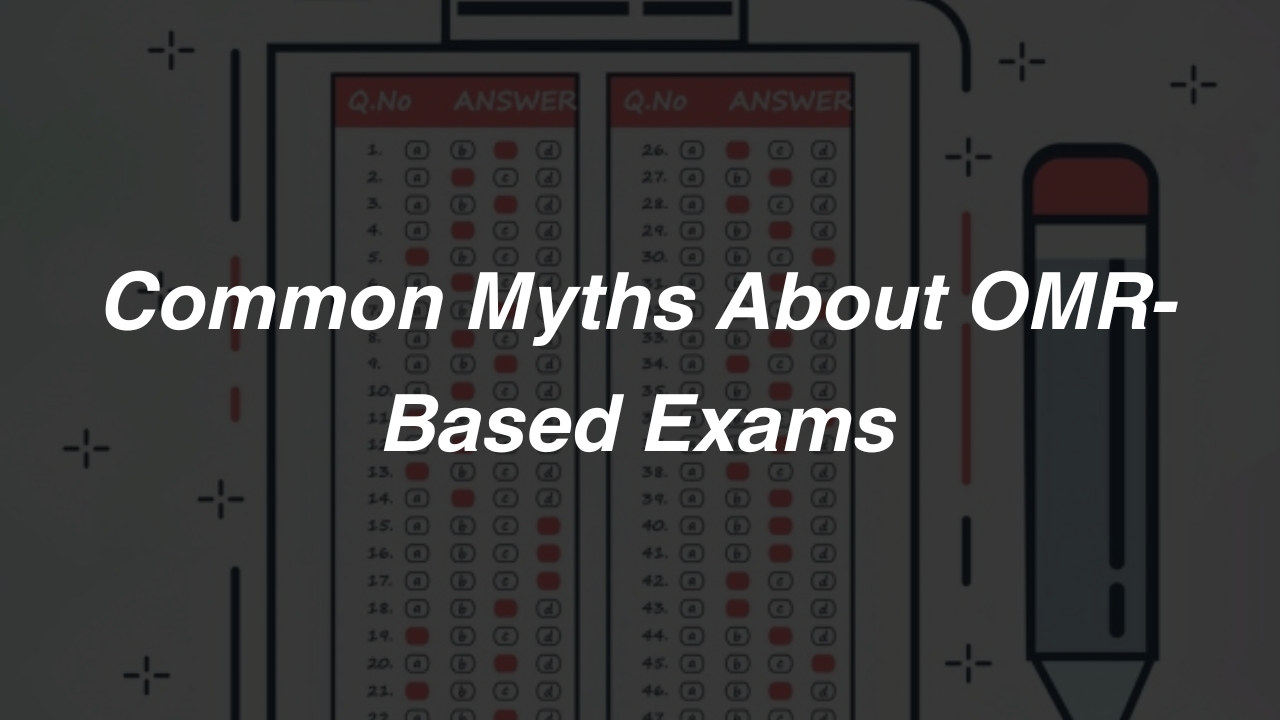
OMR (Optical Mark Recognition) technology has become a cornerstone of modern examinations in India. For decades, it has played a crucial role in ensuring accuracy, efficiency, and fairness in assessments of all sizes. From the quiet tension of a classroom quiz to the vast scale of national-level government recruitment exams, OMR continues to deliver dependable results.
In India, OMR exams are as familiar as the sound of pencils scratching across answer sheets in a crowded hall. Schools, coaching institutes, government bodies, and corporate organizations rely on this technology to evaluate knowledge objectively and efficiently. Despite its widespread adoption, several myths and misconceptions continue to surround OMR-based exams. These misunderstandings often create unnecessary anxiety among students, hesitation among educators, and uncertainty for administrators.
By addressing and debunking these myths, institutions can conduct examinations with greater confidence, and candidates can approach OMR exams calmly, knowing that the process is reliable, transparent, and fair.
Myth 1: OMR Exams Are Only for Schools
A common belief is that OMR exams are used only in schools for academic assessments. While schools do rely heavily on OMR for board exams, unit tests, and internal evaluations, the scope of OMR extends far beyond classrooms.
OMR technology is widely used by coaching institutes conducting mock tests for competitive exams, government recruitment agencies such as SSC, RRB, and state public service commissions, as well as private organizations running aptitude tests, surveys, and employee evaluations. Its ability to handle large volumes of data with consistent accuracy makes it indispensable across multiple sectors.
Myth 2: OMR Sheets Are Complicated to Use
Many students feel anxious about using OMR sheets, worrying that marking answers incorrectly could cost them valuable marks. In reality, OMR sheets are designed to be simple, intuitive, and user-friendly.
Clear instructions, properly labeled sections, evenly spaced bubbles, and alignment markers guide candidates through the process. Filling an OMR sheet requires nothing more than carefully shading the correct option. With basic familiarity and attention, the risk of errors is minimal.
Myth 3: OMR Exams Can Easily Be Cheated
Because OMR exams are paper-based, some assume they are easier to manipulate. However, most OMR exams are conducted in strictly supervised environments where even minor disturbances are closely monitored.
Additionally, modern OMR scanners are capable of detecting incomplete markings, stray pencil strokes, and damaged sheets. These safeguards significantly reduce the chances of malpractice and help maintain the integrity of the examination process.
Myth 4: OMR Exams Are Outdated in the Digital Age
With the rise of online exams and digital assessment platforms, OMR is often perceived as outdated. In practice, OMR remains highly relevant—especially in regions where internet connectivity and power supply may be inconsistent.
OMR provides a reliable offline alternative that eliminates risks such as server crashes, connectivity failures, or device incompatibility. For large-scale exams involving thousands of candidates, OMR offers stability, speed, and dependable results.
Myth 5: OMR Exams Can Only Handle Multiple-Choice Questions
Another widespread misconception is that OMR exams are limited to multiple-choice questions. While MCQs are commonly used, OMR sheets can also support other objective formats such as matching, ranking, and sequence-based questions.
Many institutions adopt a hybrid approach, using OMR for objective sections while evaluating descriptive answers manually. This combination ensures comprehensive assessment without compromising efficiency.
Myth 6: OMR Results Are Not Reliable
Some candidates worry that automated evaluation may lead to inaccuracies. In reality, modern OMR systems are designed to reduce human error rather than introduce it.
Scanners consistently read marked responses, and software compares them against answer keys with precision. Multiple quality checks help ensure that results are accurate, consistent, and fair.
Myth 7: Only Large Institutions Can Use OMR
OMR technology is often thought to be expensive and suitable only for large organizations. Today, scalable solutions make OMR accessible to institutions of all sizes.
Small schools, local coaching centers, and even businesses can outsource OMR processing to professional providers, reducing the need for costly hardware while maintaining high accuracy.
Myth 8: OMR Exams Are Impersonal and Stressful
Some students feel that OMR exams are rigid and impersonal. However, stress often stems from unfamiliarity rather than the format itself.
With practice and clear instructions, candidates quickly become comfortable with OMR exams. Fast result processing and transparent evaluation often reduce anxiety compared to manual checking.
Why Understanding These Myths Matters
Debunking myths around OMR exams benefits all stakeholders. Institutions gain confidence in adopting a reliable and scalable evaluation system. Students experience reduced stress and improved performance. Administrators are empowered to make informed decisions when balancing OMR with other assessment methods.
Conclusion
OMR-based examinations remain a proven, efficient, and trustworthy evaluation method across India. By combining speed, accuracy, and scalability, OMR continues to support schools, coaching institutes, government bodies, and corporate organizations—even in an increasingly digital world.
When implemented correctly, OMR technology saves time, reduces errors, and ensures fair assessment, making it an indispensable tool in modern evaluation systems.
 Simplify complex operations with custom-built tech
 Ensure growth through automation and smart digital tools
 Reach wider audiences with scalable online infrastructure