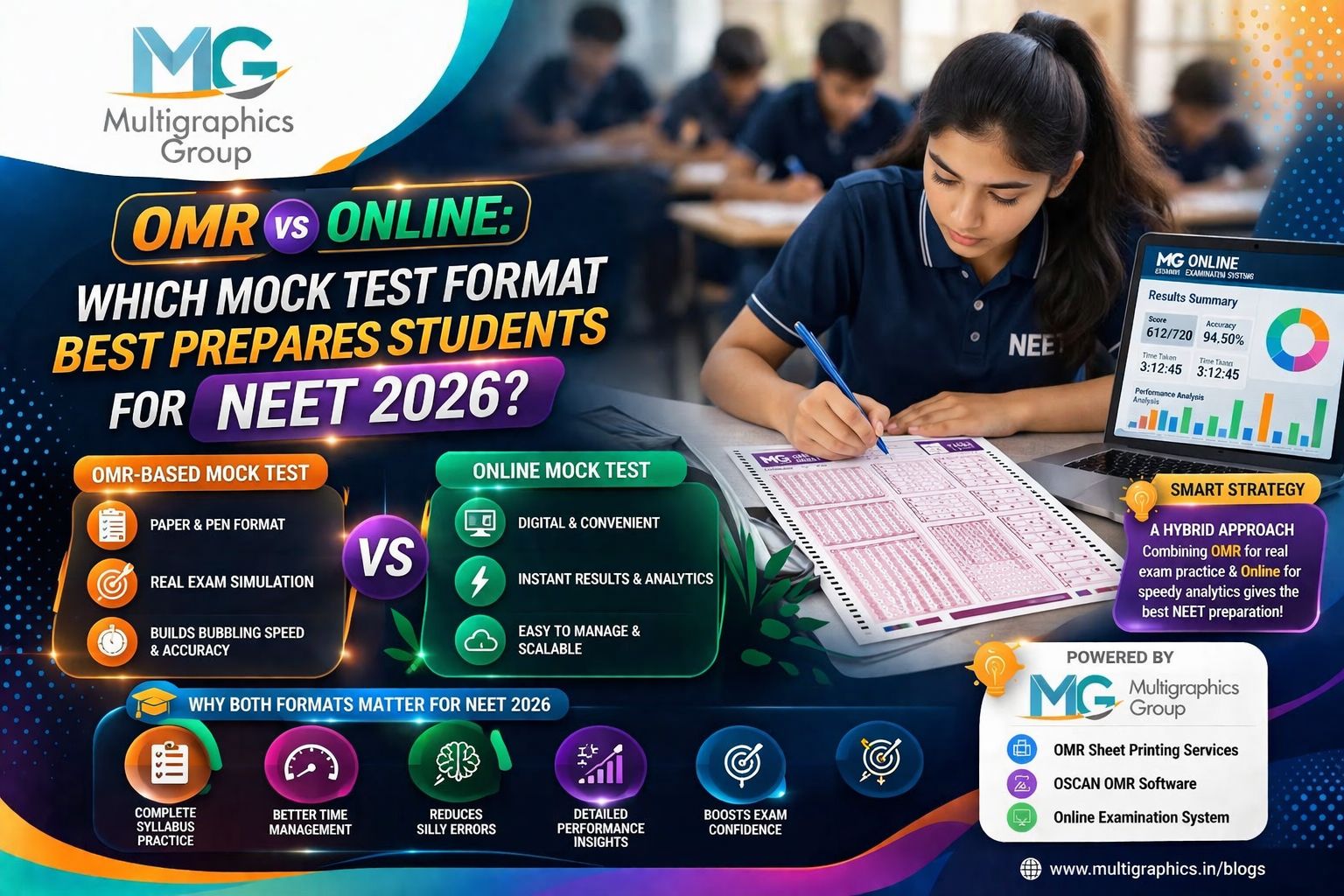
Introduction
As the competition for medical seats in India reaches unprecedented levels, coaching institutes face a critical decision: should they conduct mock tests on an OMR-based system or move entirely to digital platforms? This choice is not merely an administrative one; it directly impacts a student’s ability to perform on the actual day of the National Eligibility cum Entrance Test (NEET).
Choosing the right format requires a deep understanding of the current examination landscape. While digital learning is the norm, the final assessment remains rooted in tradition. This blog explores the OMR vs online mock test NEET debate to help coaching directors and students build a winning preparation strategy.
Understanding NEET Exam Format (Reality Check)
Before choosing a testing format, one must acknowledge the ground reality of the NEET examination. Despite the digital transformation across various national-level exams like JEE or CUET, NEET remains an offline, pen-and-paper examination.
The National Testing Agency (NTA) continues to utilize a physical OMR-based system. Students must manually darken bubbles on a sheet to record their answers. Consequently, a student who has only practiced on a computer screen may find the transition to a physical paper-and-pen format during the actual exam jarring and time-consuming.
Authorized Writing Instruments : Students must use only a blue or black ballpoint pen. Pencils are strictly prohibited because their lead reflects light differently, which often leads to scanning failures. Gel pens are also barred as the ink can seep through the paper, affecting the reverse side or smudging nearby bubbles.
The "One Bubble" Rule : Each question has only one correct response. Darkening more than one bubble for a single question results in an "invalid" response, and negative marking will still apply.
Identification Integrity : Details such as the Roll Number, Test Booklet Code, and Test Booklet Serial Number must be written in the boxes and then bubbled in the columns below. A mismatch in this section is the most common reason for a result being withheld.
No Stray Marks : Automated scanning removes human bias and manual errors from result processing, ensuring every student is evaluated fairly.
Tampering & Corrections : The use of white fluid (whitener), blades to scratch out ink, or erasers is strictly forbidden. The OMR paper is chemically sensitive; therefore, tampering with the surface often renders the entire sheet unreadable.
Mandatory Signatures : Candidates must sign the declaration in their own handwriting. Additionally, a left-hand thumb impression is required on the attendance sheet, which must be clear and un-smudged.
What is OMR-Based Mock Testing ?
OMR-based testing is the traditional offline assessment method that mirrors the actual NEET environment. In this system :
Paper-Based Testing : Students receive a physical question booklet and an OMR answer sheet.
Bubbling Answers : Candidates use a ballpoint pen to fill circles (bubbles) corresponding to their chosen options.
Physical Handling : Students must manage a physical sheet, ensuring it remains crisp, clean, and free of stray marks.
Real Exam Simulation : This format recreates the exact tactile experience and psychological pressure of the NEET examination hall.
What is Online Mock Testing ?
Online mock testing involves a computer-based interface where students interact with questions digitally. Key features include :
Computer-Based Test (CBT) : The exam is hosted on a portal accessible via PCs, laptops, or tablets.
Digital Interface : Questions are presented one by one or in a list, and students click to select their answers.
Instant Results : The system automatically calculates scores the moment the student clicks "Submit."
Timer & Navigation : The interface usually includes a visible countdown timer and easy navigation buttons to skip or mark questions for review.
OMR vs Online Mock Tests: A Detailed Comparison
To help coaching institutes decide which system to adopt, we must compare them across several critical dimensions:
| Feature | OMR-Based Testing | Online Mock Testing |
|---|---|---|
| Exam Simulation Accuracy | 100% (Identical to NEET reality) | Low (Different from NEET reality) |
| Time Management | Includes time for bubbling (20-30 mins) | Instant selection (no bubbling time) |
| Error Probability | Risk of wrong bubbling or double marking | Risk of accidental clicks/tech glitches |
| Student Comfort | Builds physical "muscle memory" | Highly convenient and mobile-friendly |
| Result Analysis | Requires scanning; detailed via software | Instant, automated analytics |
| Infrastructure Needs | Printing and scanning hardware | Reliable internet and computer labs |
Advantages of OMR-Based Testing (For NEET)
For a NEET aspirant, OMR practice is not an option; it is a necessity. The best mock test format for NEET must prioritize simulation over convenience.
-
✔
Real Exam Match :
Practicing on OMR ensures there are no surprises on the exam day regarding the sheet's layout or the bubbling process.
-
✔
Muscle Memory :
Repeatedly filling bubbles helps students develop a rhythm, reducing the risk of stray marks or incomplete filling.
-
✔
Accuracy Training :
In OMR, once a bubble is darkened, it cannot be changed. This teaches students to be 100% certain before marking, unlike online tests, where answers can be changed repeatedly.
To support this, coaching institutes rely on professional OMR sheet printing services to ensure students practice on sheets that meet NTA standards.
Advantages of Online Testing
While NEET is offline, an online examination system offers unique advantages during the early and middle stages of preparation.
-
✔
online examination system :
Online platforms provide immediate feedback on topic-specific strengths and weaknesses, helping students quickly adjust their study plans.
-
✔
Easy Management :
Institutes can conduct daily quizzes or small-scale tests without the logistical burden of printing and physical collection.
-
✔
Scalability :
An online system can accommodate thousands of students across different geographical locations simultaneously with zero physical logistics.
Which Format Should Coaching Institutes Choose?
A binary choice between OMR and Online is often counterproductive. The most successful NEET mock test strategy utilized by top-tier coaching institutes is a Hybrid Approach
Early in the academic session, an online system is ideal for "Chapter-wise" or "Topic-wise" tests. It provides the rapid feedback required to clear concepts. However, as the exam approaches, the focus must shift to full-length OMR-based simulations.
For this transition to be effective, institutes need robust backend support. Using specialized OSCAN OMR software allows institutes to bridge the gap by providing digital-grade analytics for physical paper tests. Furthermore, professional OMR scanning and processing solutions ensure that even with thousands of physical sheets, the results are processed with the speed and accuracy of an online system.
Role of MultiGraphics in Supporting Both Systems
At MultiGraphics, we understand that modern coaching institutes require a versatile toolkit to produce top-rankers. We provide a complete testing ecosystem that covers both ends of the spectrum.
For the OMR-based needs of NEET, MultiGraphics offers high-precision OMR sheet printing services and industrial-grade OMR scanning and processing solutions. Our proprietary OSCAN OMR software is designed to handle high volumes, providing institutes with deep performance insights.
Simultaneously, we empower institutes with a sophisticated online examination system for their daily practice needs. This dual-capability ensures that whether a test is conducted on a screen or on paper, the evaluation is seamless and error-free. You can explore our full range of academic solutions at MultiGraphics.
Conclusion
The OMR vs online mock test NEET debate isn't about which format is superior, but which is more relevant. Because NEET 2026 remains a pen-and-paper exam, OMR-based simulation is the gold standard for final preparation. However, integrating an online system for concept-building ensures a well-rounded strategy.
By choosing MultiGraphics as your testing partner, coaching institutes can offer the best of both worlds—technological efficiency and exam-room reality. Ensure your students are not just prepared but are "format-ready" for the challenges of NEET 2026.
About Us
India's Leading
EdTech Solution Provider
We don't just build tech — we build results.
Multigraphics Group builds scalable solutions across EdTech, training, software development, mobile apps, digital marketing, and exam tech.
We help institutions and businesses automate, digitize, and grow — using the systems and resources they already have.
-
 Simplify complex operations with custom-built tech
-
 Ensure growth through automation and smart digital tools
-
 Reach wider audiences with scalable online infrastructure